
LED flashing lights are entirely unregulated. There is no limit to how intense they can be or how rapidly they flash. This lack of regulation has lead to epileptic seizures, migraines, panic attacks, eye damage, decreased vision and increased risk of injury and death.
Example of Safe Flashing Lights
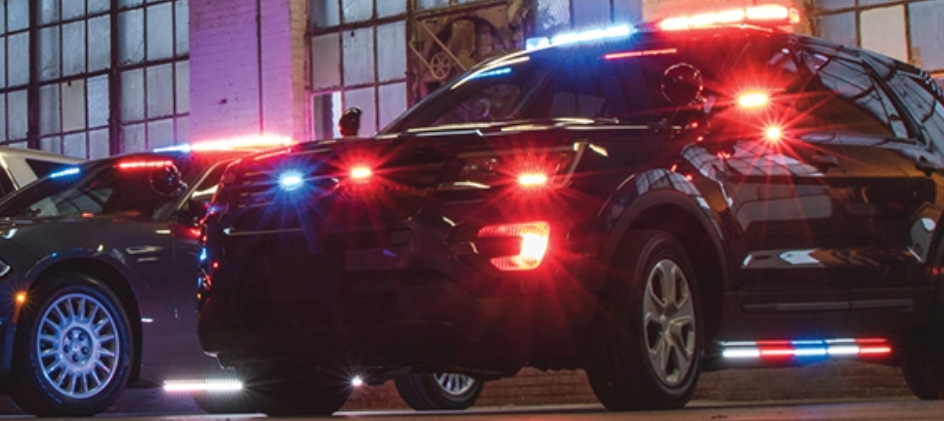
Examples of Dangerous LED Flashing Lights
WARNING: SEIZURE TRIGGERS!
The manufacturers of these LED Flashing lights admit that they cause momentary blindness and/or eye damage, as shown in this warning label from Whelen Engineering.

A company called Fleet Safety proudly displays these eye-damaging devices on their website.
Rectangular Rapid Flashing Beacons
RRFBs direct high-intensity, rapidly flashing light directly into the eyes of drivers, forcing them to stop through fear, intimidation, and loss of vision. The design of these devices is inherently unsafe, placing public health and safety in jeopardy.
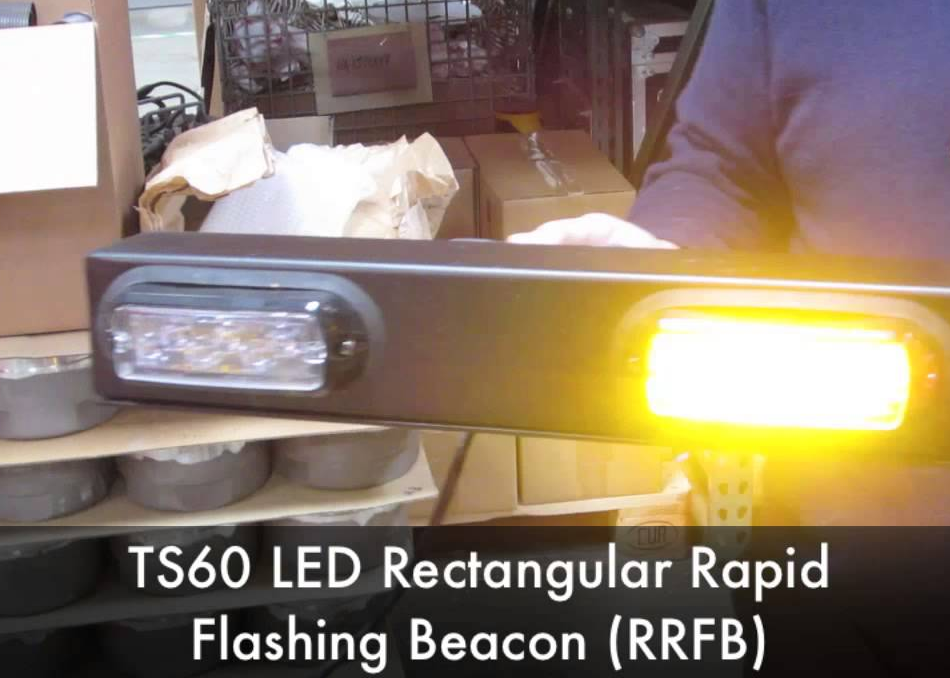
In the marketing video below, the narrator says “attention grabbing strobe lights” at the 0:20 mark. The fact that the manufacturer admits that the RRFB is a strobe light is significant, since the Federal Highway Administration has not authorized strobe lights for flashing beacons. Additionally, the narrator claims that the RRFB has significantly more surface and is brighter and more eye catching, all dangerous actions. The narrator claims “easy installation”, which also implies easy removal, which would eliminate any contention by a city that removal of an RRFB is a cost burden.
https://www.youtube.com/embed/KBltx0Argag?feature=oembedRRFB Marketing
The RRFB was initially given interim approval by the FHWA, then that that approval was revoked due a patent issue. Once the patent issue was resolved, the FHWA again authorized interim approval, requiring each state to request individual approval from the FHWA.
https://mutcd.fhwa.dot.gov/resources/interim_approval/ia21/index.htm – RRFB Interim approval.
https://mutcd.fhwa.dot.gov/resources/interim_approval/ia21/faq/index.htm – RRFB interim approval.
The Manual of Uniform Traffic Control Devices is the standard for highway signs and is maintained by the Federal Highway Administration. Many states have their own state version of this same document with slight modifications particular to the state.
Manual of Uniform Traffic Control Devices – This is a link to the current version, 2009.
Chapter 4L – Flashing Beacons –
Quote: “Beacons shall be flashed at a rate of not less than 50 or more than 60 times per minute. The illuminated period of each flash shall be a minimum of 1/2 and a maximum of 2/3 of the total cycle.” – RRFBs flash much faster than once per second. Therefore, RRFBs do not comply with the MUTCD.
Quote: “The advance warning area may vary from a single sign or high-intensity rotating, flashing, oscillating, or strobe lights on a vehicle to a series of signs in advance of the TTC zone activity area.” – The MUTCD does not define the difference between a flashing light or strobe light. However, since RRFB means Rectangular Rapid Flashing Beacon, we would understand that RRFBs must comply with section 4L, Flashing Beacons. The marketing video for the RRFBs states that they are “attention grabbing strobe lights”, so the manufacturer seems to consider the RRFB to be a strobe light, which is not an approved device.
Effects of Yellow Rectangular Rapid-Flashing Beacons on Yielding at Multilane Uncontrolled Crosswalks. – 2010 study by FHWA – An early study of RRFBs by the FHWA
Evaluation of Pedestrian Hybrid Beacons and Rapid Flashing Beacons – 2016 Texas A&M Study. The study invalidly uses candela to measure optical power. For surface sources such as LED, the correct metric is candela per square meter. There is no discussion of cd/m2 which is the brightness and power metric for surface source emitters.
On March 6, 2022, the Soft Lights Foundation requested termination of the interim approval of RRFBs because they are dangerous and discriminatory. – Letter to FHWA – In our letter, we noted that the researcher used data for point sources, rather than the correct data for surface source LEDs. The research on RRFBs is thus invalid.
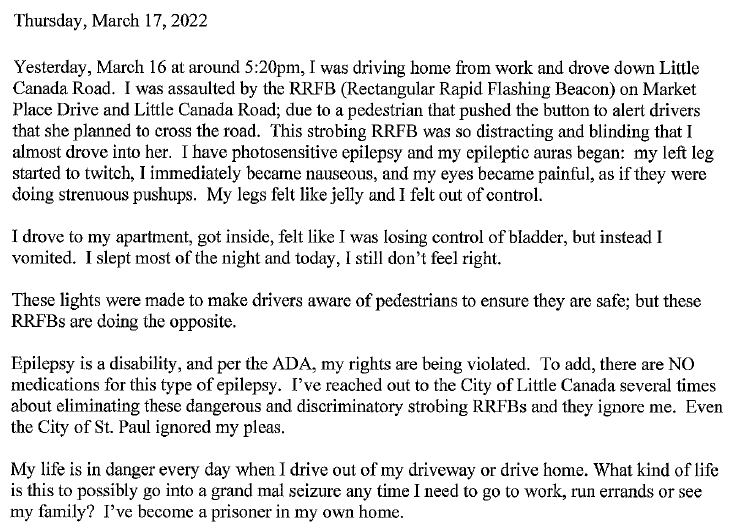
The Soft Lights Foundation was sent this letter detailing the injury caused by RRFBs.
Strobe Lights
There is no definitive agreement on the definition of strobe light. However, in general, the definion of strobe light is similar to the one found in the Britannica dictionary. “A bright light the flashes on and off very quickly.” – https://www.britannica.com/dictionary/strobe-light
LED flashing lights are intense, directed energy beams that flash on and off in a digital manner. Companies such as Carmanah claim that their RRFBs are strobe lights. Police reports and discussion groups refer to LED flashing lights as strobe lights. Therefore, there is little doubt that LED flashing lights are strobe lights and not simply flashing lights.
Assault
Below are legal definitions of assault. RRFBs are obviously designed to instill fear and apprehension into drivers. That’s why the light is so intense and flashing so rapidly. This constitutes assault.
“The definition of assault varies by jurisdiction, but is generally defined as intentionally putting another person in reasonable apprehension of an imminent harmful or offensive contact. Physical injury is not required.” – https://www.law.cornell.edu/wex/assault
“Assault is often defined as any intentional act that causes another person to fear an attack or imminent physical harm. This definition recognizes that placing another person in fear of bodily harm is itself an act deserving of punishment, even if the victim of the assault is not physically harmed.” – https://www.nolo.com/legal-encyclopedia/assault-battery-aggravated-assault-33775.html
“An intentional act by one person that creates an apprehension in another of an imminent harmful or offensive contact.” – https://legal-dictionary.thefreedictionary.com/assault
Suing a City
Ohio – Cities are generally immune for liability, but there are exceptions. “If someone’s injuries result from physical defects that occur due to negligence within or on the grounds of buildings that are used for governmental functions, or due to the negligent failure to repair or remove obstructions on a public road, then a city may be liable.” – https://www.ohiobar.org/public-resources/commonly-asked-law-questions-results/personal-injury/when-can-a-city-be-sued-for-personal-injury/
Iowa – “Every municipality is subject to liability for its torts and those of its officers and employees, acting within the scope of their employment or duties, whether arising out of a governmental or proprietary function.” – https://www.legis.iowa.gov/docs/ico/chapter/670.pdf –
Minnesota – “Every municipality is subject to liability for its torts and those of its officers, employees and agents acting within the scope of their employment or duties whether arising out of a governmental or proprietary function.” – https://www.revisor.mn.gov/statutes/cite/466/full
Oregon – “Every public body is subject to civil action for its torts and those of its officers, employees and agents acting within the scope of their employment or duties, whether arising out of a governmental or proprietary function or while operating a motor vehicle in a ridesharing arrangement authorized under ORS 276.598 (Car or van pools).” – https://oregon.public.law/statutes/ors_30.265
NHTSA Steady Burning Requirement
The National Highway Traffic Safety Administration (NHTSA) requires all auxiliary vehicle warning lamps to be steady burning. This means that any auxiliary warning lamp such as on a police car or tow truck cannot flash. Despite this federal requirement, there are likely millions of vehicles on the roads using flashing lights. This is because NHTSA defers enforcement of the steady burning requirement to the States.
49 C.F.R. 571.108(S6.2.1) states, “No additional lamp, reflective device, or other motor vehicle equipment is permitted to be installed that impairs the effectiveness of lighting equipment required by this standard.” Decades of studies have shown that flashing lights impair vision and thus for decades, NHTSA has required that all auxiliary vehicle lamps be steady burning.
On June 27, 2024 and December 13, 2024, NHTSA issued Letters of Interpretation reaffirming the steady burning requirement. NHTSA wrote, “FMVSS No. 108 requires that all auxiliary lamps be steady burning except for auxiliary lamps that supplement required lamps that flash, such as turn signals.” and “NHTSA’s longstanding interpretation of FMVSS No. 108 is that the standard does not permit the “emergency warning lights” to be installed as original equipment because they are auxiliary lighting that is not steady burning and would impair the effectiveness of required lamps by causing confusion among other drivers about the meaning of required lighting or distracting drivers from required lighting.”
On May 18, 2026, the Eighth Circuit Court of Appeals ruled that NHTSA’s Letters of Interpretation can be considered as Final Agency Action. In the case Brake Plus NWA, Inc. v. Department of Transportation, NHTSA file an Opposition to Plaintiffs’ Preliminary-Injunction Motion on November 15, 2023. In this brief, NHTSA referred to “steady burning” lamps over 40 times and stated, “NHTSA has for decades interpreted ‘steady burning’ to exclude pulsing lights and reiterating that long-held view does not unsettle established reliance interests.” and “That interest is served through the Notification Letters as the Government maintains that pulsing stop lamps hinder public safety by causing confusion among drivers.”
49 U.S. Code § 30103 (b) states, “(1)When a motor vehicle safety standard is in effect under this chapter, a State or a political subdivision of a State may prescribe or continue in effect a standard applicable to the same aspect of performance of a motor vehicle or motor vehicle equipment only if the standard is identical to the standard prescribed under this chapter. However, the United States Government, a State, or a political subdivision of a State may prescribe a standard for a motor vehicle or motor vehicle equipment obtained for its own use that imposes a higher performance requirement than that required by the otherwise applicable standard under this chapter. (2) A State may enforce a standard that is identical to a standard prescribed under this chapter.” This means that NHTSA’s steady burning requirement occupies the whole of the field in regards to temporal modulation of auxiliary vehicle lamps. A state may have an equal or more restrictive standard, but may not implement a standard that permits non-steady burning auxiliary lamps.
California has its own statute, California Vehicle Code section 26103(c), which states, “A federal motor vehicle safety standard adopted pursuant to Chapter 301 (commencing with Section 30101) of Part A of Subtitle VI of Title 49 of the United States Code that covers the same aspect of performance of a device shall prevail over provisions of this code or regulations adopted pursuant to this code. Lamps, devices, and equipment certified by the manufacturer to meet applicable federal motor vehicle safety standards as original equipment on new vehicles and the identical replacements for those items need not be certified to the department.” California thus confirms that NHTSA’s steady burning requirement supersedes any California statute to the contrary.
Police Chief Magazine wrote, “When 10 or 20 of them are placed on an emergency vehicle parked at night along a roadway, the lights may actually be creating a condition that is less safe than a similar scenario with the older light sources, despite being compliant with the lighting standards.” and “Some subjects had to look away while approaching the car, while others could not take their eyes off the flashing blue, red, and amber glare.” and “Officers who have participated in a multicar response know what it is like to follow a car with intense flashing lights and not be able to see the brake lights as a result.” These quotes provide support for NHTSA’s steady burning requirement.
This animation shows how flashing lights and colors can impair location detection. WARNING: SEIZURE TRIGGER!
In 2002, NHTSA published Enhanced Rear Lighting and Signaling Systems: Literature Review and Analyses of Alternative System Concepts. NHTSA wrote, “”The scientific literature has not shown any significant improvement in drivers’ detection of flashing lamps versus steady-burning lamps. Without additional scientific research showing that a flashing lamp will be detected significantly faster than a steady-burning lamp, NHTSA will not consider altering the standard.”
On December 31, 2007, the California Department of Transportation published the report Workzone Safety Improvements through Enhanced Warning Signal Devices. Caltrans wrote, “One part of the problem may be pervasiveness: too many other vehicles employ a flashing amber signal similar to the usual EWL.” and “As mentioned in the companion report on the Shadow Truck Warning Signal the trend toward increasing signal intensity may be doing more harm than good.”
The AAA Foundation for Traffic Safety published a report in April, 2025 titled Roadside Assistance Vehicle Lighting: Review of Scientific Research and State Regulations. AAA FTS wrote, “The use of too many lights at an incident scene can be distracting and can create confusion for approaching road users, especially at night.” and “However, too much light or certain flash patterns can create glare or distractions for approaching motorists, among other effects.” and “As vehicles near the towing scene, glare and distraction from flashing warning lights and work lights can make it difficult to see personnel on foot, potentially contributing to worker casualties.”
The Virginia Transportation Research Council published a report titled Deceleration Lights on Trucks: A Report to the Governor and General Assembly of Virginia in Response to Senate Joint Resolution No. 247, 1993
Legislative Session. The VTRC wrote, “First and foremost, Virginia must take care that the lamps it approves do not impair the effectiveness of federally required lighting equipment. NHTSA and FHWA have offered two indications as to how that might be avoided: (1) by allowing only steady-burning lamps to be used as a part of deceleration warning systems” and “It was previously noted that flashing deceleration signals are not allowable under NHTSA’s current interpretation of Standard No. 108. If the indications of the 1980-81 study are correct, there is little reason to think that flashing lights would offer any safety advantage over similarly situated steady burning lamps.”
49 CFR § 1.95(c) states, “The National Highway Traffic Safety Administrator is delegated authority to Carry out, in coordination with the Federal Motor Carrier Safety Administrator, the authority vested in the Secretary by subchapter III of chapter 311 of title 49, U.S.C., to promulgate safety standards for commercial motor vehicles and equipment subsequent to initial manufacture when the standards are based upon and similar to a Federal Motor Vehicle Safety Standard promulgated, either simultaneously or previously, under chapter 301 of title 49, U.S.C.” This means that any FMCSA standard for exemption for vehicle flashing lights is preempted by NHTSA standards, unless the FMCSA standard is more restrictive.
Flashing Light Studies and Articles
2022 – To our knowledge, no studies have been performed to verify that rapidly flashing LED light is safe for those with epilepsy, autism, migraines, PTSD or other neurological sensitivities or that this light is safe for human eyes.
April 22, 2022 – Can behavioral interventions be too salient? Evidence from traffic safety messages. – Electronic signs are distracting and lead to more crashes.
February 7, 2022 – Visually sensitive seizures: An updated review by the Epilepsy Foundation – The abstract states that visually-induced seizures remain significant public health hazards so they warrant ongoing scientific and regulatory efforts and public education and that images with flashes brighter than 20 candelas/m2 at 3-60 (particularly 15-20) Hz occupying at least 10 to 25% of the visual field are a risk. This confirms that LED flashing lights will trigger epileptic seizures.
December, 2021 – Effects of Emergency Vehicle Lighting Characteristics on Driver Perception and Behavior – This study concludes that high intensity flashing lights put lives at risk.
January 28, 2021 – How Do Flashing Lights Trigger Epileptic Seizures? – This overview article mentions that contrast is a trigger, as is flash rate.
June 11, 2019 – Stroboscopic light effects during electronic dance music festivals and photosensitive epilepsy: a cohort study and case report The connection between strobe lights and seizures.
April 2, 2019 – Impacts of Flashing Emergency Lights This study concludes that strobing LED lights are dangerous.
January, 2018 – Police Warning Signals – This article in Police Chief Magazine discusses the dangers of overly intense strobing lights.
June 5, 2016 – Why Running Lights and Sirens is Dangerous – Flashing Lights and Sirens may save a few minutes, but does not change the outcome of the event. There is no value to using them, but there is harm.
June 1, 2016 – National Institutes of Health – Psychological Factors in Exceptional, Extreme and Torturous Environments This scientific research shows that strobing LED lights are instruments of torture.
2012 – Assessing the Photobiological Safety of LEDs – 2012 report by Underwriters Laboratories. – Basically, there are no eye safety regulations for LEDs.
October, 2010 – Ambulance Lights – Article on ambulance lights. “Fewer lights, flashing slower & less brightly are more effective.”
August 5, 2001 – Rear Lighting Configurations for Winter Maintenance Vehicles Strobing lights are less effective than static lights for safety.
December 27, 1955 – Siren, Light Removal Makes Police Unhappy – “Removal of the sirens and red lights has materially reduced accidents involving police cars rushing to other smashups or speeding to the scene of a crime.”
April, 2025 – Roadside Assistance Vehicle Lighting: Review of Scientific Research and State Regulations – “The most important take-away from prior research is that interventions intended to improve the long-distance visibility of special-purpose vehicles often appear to have adverse effects on the visibility of personnel near the vehicles.”
November, 2024 – Securing the Perception of Advanced Driving Assistance Systems Against Digital Epileptic Seizures Resulting from Emergency Vehicle Lighting – LED flashing lights interfere with automated driving systems.
October 4, 2024 – International Guidelines for Photosensitive Epilepsy: Gap Analysis and Recommendations – Limit brightness difference between flashing states to a luminance of 20 cd/m2.
February, 2024 – Good Practices and Current Research in Vehicle Lighting for Roadway Incidents – Researcher John Bullough discusses LED flashing lights starting at 14:05 and ending at 37:50.
October 26, 2022 – Team-driven Improvement in the Use of Lights and Sirens – Discussion of the dangers of using lights and sirens.
April 22, 2022 – Can behavioral interventions be too salient? Evidence from traffic safety messages. – Electronic signs are distracting and lead to more crashes.
March 29, 2022 – Flashing Emergency Lights: Influence of Intensity, Flash Rate and Synchronization on Driver Visibility, Comfort and Confidence – Flashing lights can be too bright and flash too quickly.
February 7, 2022 – Visually sensitive seizures: An updated review by the Epilepsy Foundation – The abstract states that visually-induced seizures remain significant public health hazards so they warrant ongoing scientific and regulatory efforts and public education and that images with flashes brighter than 20 candelas/m2 at 3-60 (particularly 15-20) Hz occupying at least 10 to 25% of the visual field are a risk. This confirms that LED flashing lights will trigger epileptic seizures.
January 27, 2022 – Video of Dodge Charger Driver Dead – Police vehicles with high-intensity LED flashing lights.
December, 2021 – Effects of Emergency Vehicle Lighting Characteristics on Driver Perception and Behavior – This study concludes that high intensity flashing lights put lives at risk.
August, 2021 – Risk of Fire Alarm Strobe Lights – An article by a risk management expert on LED strobe lights used in buildings.
July 1, 2021 – Altered states phenomena induced by visual flicker light stimulation – Strobing lights can induce altered consciousness.
June 30, 2021 – Study of Heart Rate and Blood Pressure Subject to Pulsed LED Lighting – The findings indicate that pulsed light will cause a deviation of heart rate and blood pressure from that under stable light. Results showed that after a short lighting period (20 min), heart rate and blood pressure were significantly higher under 40 Hz pulsed than that under stable light.
January 28, 2021 – How Do Flashing Lights Trigger Epileptic Seizures? – This overview article mentions that contrast is a trigger, as is flash rate.
January 9, 2021– California Highway Patrol – Video of CHP vehicle on roadway with high luminance LED strobe lights.
June 11, 2019 – Stroboscopic light effects during electronic dance music festivals and photosensitive epilepsy: a cohort study and case report The connection between strobe lights and seizures.
April 2, 2019 – Impacts of Flashing Emergency Lights This study concludes that strobing LED lights are dangerous.
February 9, 2019 – Massachusetts State Police – Compilation video showing high luminance strobe lights on MSP vehicles.
January 12, 2019 – Is Use of Warning Lights and Sirens Associated With Increased Risk of Ambulance Crashes? A Contemporary Analysis Using National EMS Information System (NEMSIS) Data – Ambulance use of lights and sirens is associated with increased risk of ambulance crashes.
January, 2018 – Police Warning Signals – This article in Police Chief Magazine discusses the dangers of overly intense strobing lights.
May 2, 2017 – Flashing Lights Induce Prolonged Distortions in Visual Cortical Responses and Visual Perception – A flashing light induces an anomalously delayed response in the primary visual cortex of mice, rats, and humans.
June 5, 2016 – Why Running Lights and Sirens is Dangerous – Flashing Lights and Sirens may save a few minutes, but does not change the outcome of the event. There is no value to using them, but there is harm.
June 1, 2016 – National Institutes of Health – Psychological Factors in Exceptional, Extreme and Torturous Environments This scientific research shows that strobing LED lights are instruments of torture.
April 18, 2014 – Hazardous Effects of Light Stimulation in the Central Nervous System – High–temporal–frequency visual stimuli can yield hazardous responses in the central nervous system.
October, 2010 – Ambulance Lights – Article on ambulance lights. “Fewer lights, flashing slower & less brightly are more effective.”
2005 – Photic- and Pattern-induced Seizures: Expert Consensus of the Epilepsy Foundation of America Working Group – A pre-LED study of how flashing lights cause seizures.
August 5, 2001 – Rear Lighting Configurations for Winter Maintenance Vehicles Strobing lights are less effective than static lights for safety.
March 22, 1971 – Failure of Visual Estimation of Motion Under Strobe – The author shows how difficult it is to catch a bean bag tossed under strobing lights.
December 27, 1955 – Siren, Light Removal Makes Police Unhappy – “Removal of the sirens and red lights has materially reduced accidents involving police cars rushing to other smashups or speeding to the scene of a crime.”Edit