The San Francisco-Oakland Bay Bridge has transitioned from a functional landmark into a source of unregulated light pollution. What began as a modest lighting scheme has expanded into Bay Lights 360—a project that bypasses environmental protections, ignores public safety standards, and creates an inaccessible environment for people with light-sensitive disabilities.
Cumulative Impact: The Eras of Light
Under California law (CCR § 15300.2), environmental exemptions are invalid when the “cumulative impact of successive projects of the same type in the same place over time is significant.” The Bay Lights 360 project is the latest in a series of installations that have fundamentally altered the San Francisco Bay.
The Progression of Intensity
- 1960s – The Natural State: Minimal light pollution. The bridge functioned as infrastructure, not a light source.
- 1986 – The 50th Anniversary: 848 incandescent lights were added as a temporary display. This established a precedent for “temporary” art that eventually became a permanent footprint.
- 2012–2023 – The LED Shift: The installation of 25,000 animated LEDs introduced high-intensity, flickering light that the Bay’s ecosystem had never previously encountered.
- 2025 – Bay Lights 360: By doubling the LEDs to 48,000 and aiming them inward toward drivers and the water, the project creates a massive spike in light pollution.
The Legal Reality: Despite this 5,000% increase in the number of lights since 1986, the Bay Area Toll Authority (BATA) claims the project has “no cumulative impact.” Our visual evidence proves otherwise.
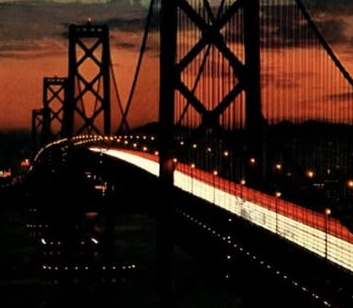
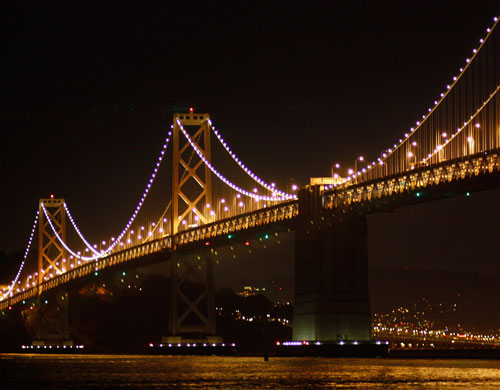
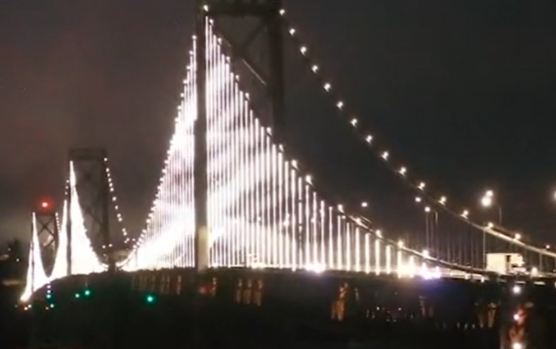
1960s – 0 decorative lights and limited light pollution.
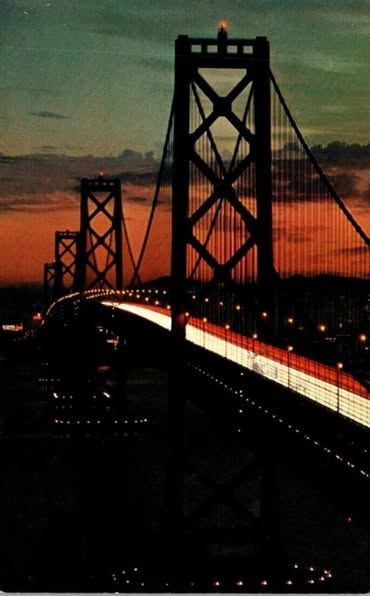
1986 – 50th Anniversary – 848 decorative lights and moderate light pollution.
2012 – 75th Anniversary – 25,000 animated LED lights with significant light pollution.
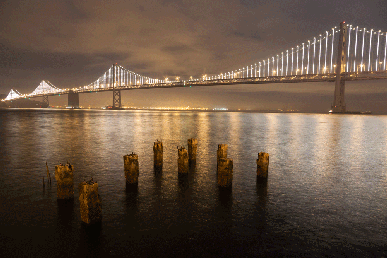
2016 – Bay Lights – 25,000 high-intensity animated LED lights with severe light pollution.
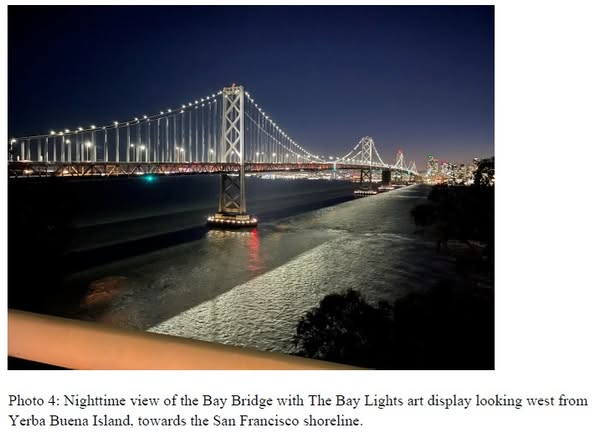
2025 – Bay Lights 360 – 48,000 high-intensity animated LED lights will double the light pollution from the previous iteration.
The light pollution from the San Francisco-Bay Bridge has increased from 0 decorative lights in the 1960s to 848 incandescent lights in 1986 to 48,000 high-intensity, blue-rich, animated LED lights in 2025.
Independent Project Evaluation
In January 2025, the Soft Lights Foundation commissioned Hamilton Biological to conduct an independent evaluation of the “Bay Lights 360” permitting process. The results were damning. President Robert Hamilton concluded that the project’s circumvention of the California Environmental Quality Act (CEQA) is legally indefensible, stating: “I conclude that your ongoing legal action to require The Bay Lights 360 project to undergo CEQA review is fully warranted.” Crucially, this conclusion is not Hamilton’s alone; the report was reviewed and explicitly endorsed by Dr. Travis Longcore, the nation’s preeminent expert on ecological light pollution. Together, they confirm that the “exemptions” claimed by BATA and Caltrans are a scientific and legal fiction.
The Shadow Project
The Bay Lights 360 project was conceived by the private individual Ben Davis, who is the founder of a non-profit called Illuminate. Mr. Davis is paid a salary through this non-profit. Mr. Davis convinced the leadership at the California Department of Transportation (Caltrans), Bay Area Toll Authority (BATA), and the San Francisco Bay Conservation and Development Commission to engage in a permit-laundering scheme to implement the Project.
Because Caltrans owns the San Francisco-Bay Bridge, the project was considered under the Caltrans Transportation Art Program. The requirements for this program are defined in the Caltrans Project Development Procedures Manual, Chapter 29. The Transportation Art procedures are contained in Section 9, which begins on page 29-78. The primary requirements include:
- Sponsorship must a local public agency defines as a city, county, town, or tribe.
- The project must be publicly funded.
- Kinetic art is prohibited.
- Public input must be solicited.
- The local public agency must issue a resolution approving the project.
None of these requirements were met for the project. Mr. Davis is the sponsor of the project, as a private individual through his non-profit, Illuminate. The project was privately funded, not publicly. The art project consists of simulate motion, which is strictly prohibited. The public was not provided an opportunity to provide input. No local public agency approved the project.
On August 15, 2023, BATA filed a California Environmental Quality Act (CEQA) Notice of Exemption (NOE), claiming that the project did not require CEQA analysis. However, an NOE can only be legally filed after project approval, which has never occurred.
On September 13, 2024, BATA applied for an encroachment permit with Caltrans for the project. BATA stated that no public agency was involved in approving the project, directly contradicting the August 15, 2023 NOE filing by BATA.
At the July 9, 2025 BATA Oversight Committee meeting, when the Committee asked about the issues with the Bay Lights 360 project, a BATA lawyer told the Committee they shouldn’t talk about the project in public due to litigation. This advice was legal malfeasance and blocked the Committee from investigating.
Because of these permitting irregularities, Soft Lights Foundation President Mark Baker filed multiple Pro Se lawsuits as an individual taxpayer. The lawsuits are document on Mr. Baker’s personal website.